…France at the end of the sixteenth century. After the death of the last king of the House of Valois, the civil war between Catholics and Protestants, in which the country has been embroiled for many years, flares up with new force. Only the accession of the rightful sovereign to the throne can bring back peace. But the heir to the throne — Henry of Navarre — is a Protestant, and the mighty Catholic League is doing everything it can to stop him becoming king. If honour is dearer to you than anything, you can help the noble Henry gain what is his by right.
Rules of the Game
Before you set out on your journey, you must determine how strong and skilful a warrior you are — that is, establish your initial SKILL and STAMINA. To do this, you roll a die and note the results on the Traveller’s Sheet, which you will find on page 14. If you have no die, the book offers you a way to do without one. In the bottom right-hand corner of every page, except at the very beginning and on the illustrations, there is a picture of one face of a die. In that case, instead of rolling the die, open the book at any spread and look in the bottom right-hand corner to see what you have “rolled”. If you happen to land on a page without a die, open the book again.
Skill and Stamina
SKILL is your mastery of the sword and your physical abilities. Naturally, the higher your SKILL, the better. STAMINA also reflects your will to live and your resolve. If it falls to zero, your strength is spent and you die. You will have to start all over again. During your journey your SKILL and STAMINA will change, so it is best either to write them small on your Traveller’s Sheet from the very start or to keep a rubber handy. But on no account rub out the scores you set out with: except where specially stated, they may not be exceeded.
SKILL is determined as follows. Roll one die and find in the table the value that corresponds to the number you rolled.
| Die roll | SKILL |
|---|---|
| 1 | 12 |
| 2 | 8 |
| 3 | 10 |
| 4 | 7 |
| 5 | 9 |
| 6 | 11 |
So, if you roll a 1, your SKILL will be 12, and if you roll a 4, it will be 7. STAMINA is determined in the same way, but from a different table.
| Die roll | STAMINA |
|---|---|
| 1 | 22 |
| 2 | 18 |
| 3 | 14 |
| 4 | 24 |
| 5 | 16 |
| 6 | 20 |
In other words, if you roll a 3, your STAMINA is 14.
Luck
LUCK is the favour shown to you by Fate and Chance. On a hard journey you will often have nothing else to rely on.
On the road you will more than once be asked to Test your LUCK. But be careful! A LUCK test carries considerable risk, and if you are unlucky, the outcome may be most lamentable.
Testing your LUCK is extremely simple. You roll one die, and if you roll an even number — 2, 4 or 6 — you are lucky. If it is odd — 1, 3 or 5 — you are unlucky.
Fights and Duels
In the pages of this book you will often meet enemies whom you will have to fight. If there is no way to avoid a fight or a duel, or if you yourself do not wish to avoid it, do as follows.
1. Roll one die for your opponent. Multiply the number rolled by 2. Add his SKILL to it. The total gives his ATTACK STRENGTH.
2. Roll one die for yourself, multiply the number rolled by 2 and add your SKILL at the time of the fight. This is your ATTACK STRENGTH.
3. If your ATTACK STRENGTH is higher than your opponent’s, you wound him (see 4). If it is the other way round, he wounds you (see 4). When they are equal, you parry the blow and continue the fight (see 1).
4. See the section “WOUNDS” below.
5. Note the new STAMINA score either for yourself or for your opponent.
6. Now fight on (see 1). And so on, until the STAMINA of one of you falls to zero. That means death. Your journey is over and, sad as it may be, you will have to start the game again. If you have won, you may boldly ride on.
In certain specially stated cases you will be given the chance to leave the field. If you wish, follow the book’s instructions, but bear in mind that flight may not succeed. And even if all goes well, you still take one wound from your opponent — that is, you lose the corresponding amount of STAMINA. And if this is not merely a battle but a duel, consider whether such a display of cowardice may deal an irreparable blow to your HONOUR.
Fighting More Than One Opponent
Sometimes you will have to fight not one but several enemies at once. In that case, before each Attack Round, choose whom your blow will be aimed at. Roll one die for each participant in the battle. Fight the opponent you have chosen exactly as described above, but in addition compare your ATTACK STRENGTH with the ATTACK STRENGTH of the other enemies. Each one whose ATTACK STRENGTH is higher than yours wounds you. You, however, can wound only your immediate opponent, even if your ATTACK STRENGTH is higher than that of the others.
Wounds
When a wound is taken, a certain amount must be deducted from the STAMINA of the wounded party, depending on the type of weapon that inflicted it. A sword and a dagger inflict the same wounds, each costing 2 STAMINA. If the wound comes from some other type of weapon, or from an accident, or is inflicted by an animal, the text will state specially how much STAMINA it costs.
Thus, during a duel, for every wound you must deduct 2 STAMINA from yourself or from your opponent, until one of you dies or until you are told to stop the duel.
Firearms
Your equipment will include one pistol. But remember: a pistol in the belt is the mark of a pirate rather than of a nobleman. Being a heavy and cumbersome weapon, a pistol was usually kept in a holster fixed to the saddle.
When setting off without a horse, people took it with them only on rare occasions — for instance, when expecting the most dangerous and, as a rule, nocturnal adventures.
Besides, reloading it after a shot was neither simple nor quick. So in a fight you will be able to fire only one shot from each pistol, and only at the very start — after that your right hand will be holding your sword. No special instruction from the book is needed for this: if you wish, fire and then begin the fight. Each shot (unless you try to fire at an enemy who is too far away) costs your opponent 4 STAMINA — at close range a hit is guaranteed. (Naturally, the same rule applies when someone fires at you.) But in addition, if you wish, you may Test your LUCK after the shot. If you are lucky, your bullet kills your opponent outright. If not, he remains safe and sound: you have missed.
And do not forget: a pistol needs powder and shot. You will have both with you, but keep count of your shots all the same. For if you run out of powder or bullets, it is hard to say whether you will be able to buy more when you need them.
Honour
Like every nobleman, you hold honour above all else. Your initial HONOUR is 3, but during your journey you may raise it by a worthy deed or lower it by a dishonourable one. If your HONOUR falls to zero, wherever you are, your journey ends there.
Fighting Arts
Before you arrive at court and present yourself to the King, you may learn one of the following arts.
1. Secret Thrust. Among fencers and duellists there have always been legends of thrusts that cannot be parried. They brought a true master certain victory in a duel. You may master one such thrust. Whatever the moment in the fight at which you use it, and whether or not you are rolling the die, you may immediately deduct 4 STAMINA from your opponent. But you can do this only once in any fight. For after that the enemy knows your secret and will be able to parry the thrust.
2. Sword and Dagger. Having mastered this art, you will be able, during a duel, to take a dagger in your left hand and strike with it at an opponent who has not mastered the same art. Of course, this is not really suited to an honourable duel (unless, naturally, the terms of the duel allow it), but in a fight it may save your life more than once. Each time you roll an even number, consider that you have managed to use your dagger. In that case, if you have won the Attack Round, deduct not 2 but 3 STAMINA from your opponent; if you have lost it, you deduct 2 STAMINA not only from yourself but also from your opponent.
3. Two Pistols. The section “Firearms” has already mentioned that firing a pistol in the sixteenth century was far harder than in the twentieth. All the more so since, given the comparatively heavy weight of the weapons, firing two pistols at once with any accuracy is not at all easy. Nevertheless, you can learn this art too. You may aim the weapons either at one enemy or at different enemies. In the first case, without testing your LUCK, you immediately deduct 8 STAMINA from your opponent. You may also Test your LUCK after either of the shots, according to the rules in the section “Firearms”. Of course, you cannot kill one man twice, but that is hardly likely to occur to you. If you fire at different enemies, follow the same rules.
Note: if you have not mastered this art but do have two pistols, you will only be able to fire them one after the other. And such a chance is unlikely to come often: after the very first shot you will usually have to cross swords with your enemies, and there will be no time to change pistols.
4. Left-Handed Fencing. If you are wounded in the right arm, you will, willy-nilly, do better to take your sword in your left hand. If you have not mastered this art, then until the wound heals you will have to reduce your SKILL, and that may be very dangerous to your life. The same rules apply when your opponent is left-handed. An untrained man has a hard time in such cases: the blows have to be parried quite differently.
5. Swimming. On the small estate where you grew up there was neither pond nor river, so you never learnt to swim. But it is never too late to make up for lost time. Of course, a river can be crossed by holding on to your horse, or more simply still by a bridge, but who knows what adventures lie ahead.
Note on your Traveller’s Sheet the art you have chosen. Remember: time is short, so you can master only ONE art. Of course, the first time you will have to choose relying on intuition alone, but nothing stops you from trying to learn something else next time.
Faith
Most of the population of France at this time are Catholics. You, however, belong to the same faith as your King — you are a Protestant, or (as they were also called then) a Huguenot. The religious differences between Catholics and Protestants are so irreconcilable that for years now Frenchman has been killing Frenchman. Quite recently, a little over fifteen years ago, in 1572, on the night of 24 August (St Bartholomew’s Day), the Catholics carried out a great massacre in Paris. Few of the Huguenots of Paris, or of those who had come there, survived, and the King himself escaped only by converting to Catholicism (which, however, did not stop him becoming a Protestant again once the danger had passed).
Like every Protestant, you may certainly hope for God’s defence and protection. But you should not trouble him over trifles. In the whole of your journey you may call on God only once, and, if you have in no way stained your faith, a miracle will happen.
Equipment and Finds
What nobleman could do without a horse and a sword! Of course, you have both. Your sharp blade is always with you, and your black horse, Arbalest, understands you at the slightest hint. Besides that, you may take one pistol with you on your journey, and from the poor treasury of the generous King you receive 15 écus. In France at that time people paid mainly in two coins — the écu and the sou. One écu was worth about 30 sous. With this money you will be able to buy everything you need on the road — from valuable information to a second pistol — but be thrifty: 15 écus is not such a great sum.
Strapped to Arbalest’s saddle are two pistol holsters and a small saddlebag, which for now holds only your cloak. Besides that, only five items can be put in it. If you find or buy more, you will have to get rid of something. Moreover, there is always the chance of losing your horse — then you will have to carry all your belongings yourself, which will hardly speed your progress or help you in a fight. Naturally, bulky items — from a second sword to a chest — will not fit in the bag, so each time you will have to think whether you can take along what has caught your eye. Well, a sword you might still manage to fix to the saddle (though you would look rather peculiar, much as if you were wearing two hats), but anything else…
As for money, it is best kept in a small bag in your pocket — that is safer. Like every Gascon, you have a bottomless purse: you may put in it as much money as you like (if, of course, you can find somewhere to get it).
Food
The journey will last more than one day, so do not forget that every man, even if he is a Gascon and a nobleman, needs to eat and sleep. If at least once a day you do not do one or the other, you will lose STAMINA. You may take food for only two meals with you on the road. Each meal restores 2 STAMINA. Since you will have to ride as fast as possible, no baggage train with provisions will keep up with you. However, the road will take you through many towns and villages: buying food will be no problem.
And one last thing. There is no point reading the book straight through. That will only confuse you and stop you making the right decision at the right moment. Read only those paragraphs, and only in the order, that the book itself offers you. Remember the main thing — EVERYTHING DEPENDS ON YOU ALONE!
Traveller’s Sheet
Everything written on these pages will help you on the road. Once you have determined your SKILL and STAMINA, note them on this page: it will then be easier for you to make all the necessary changes. Here, too, you may record changes in your HONOUR, as well as everything you find or learn on the way.
It may turn out that the task before you is too difficult to accomplish at the first attempt. So it is best to copy out or photocopy this page from the very start.
Preface
The end of August 1589. Less than a month ago the last French king of the House of Valois, Henry III, who left no heirs, was murdered by a fanatical monk. Another Henry, the King of Navarre, the closest relative of the Valois, is to ascend the throne. But there is an insurmountable obstacle to this — he is a Protestant, and France is a Catholic country.
Besides him, the mighty princes of Lorraine — the Guises — laid claim to the throne, vainly trying to prove that they had more right to it than the Valois themselves. To fight Henry of Navarre, and perhaps to seize the throne as well, they created a powerful organisation whose network entangled the whole country: the Catholic League. The priests — and the Guises enjoyed the support of the Pope himself — said that every true Catholic was bound to help the League if he did not want to burn in Hell after his death. Weary of attempts on his life and his throne, Henry III ordered the murder of two leaders of the League, two of the Guises — Henry, known as le Balafré (the Scarred), and the Cardinal of Lorraine — but he himself did not escape the hand of the League.
After his death the civil war, in which France had been embroiled for many years, flared up with new force. Henry of Navarre was now opposed by the surviving leader of the League, Charles de Guise, Duke of Mayenne. Only the accession of the rightful sovereign to the throne could restore peace to France.
If you wish, at the risk of your life, to help the noble King Henry restore justice and win the French throne, then a long road full of adventure awaits you. You arrive in Agen, a small southern town where the court of the King of Navarre is held…
You are a Gascon, the son of a nobleman of modest means who was killed during the wars of religion. Henry once knew your father well, so you have no difficulty in being presented at court and receiving an invitation to the royal table. When supper was over, you were unexpectedly told that Henry wished to speak with you alone. A few minutes later you are standing before the King.
Inviting you to sit with a weary gesture (in this palace they do not yet trouble themselves much about etiquette), the thirty-five-year-old monarch comes straight to the point:
“I think there is no sense in wasting time on preambles and persuasion. I knew your father, and if you are even half as brave and resolute as he was, that will be enough. I urgently need a man who can get to Paris quickly and find several people there. Until St Bartholomew’s Night you lived in the capital for several years, and your house there has surely survived. That is one. To judge by the recommendations, you are desperately brave. That is two. You are not known at court, so the spies will have less chance of tracking you down. That is three. That is why my choice has fallen on you. Make up your mind. You will have to leave tomorrow at dawn.”
Rising, you bow, showing that you await further orders.
“Excellent. So I was not mistaken. Even here, in the Protestant south, in your homeland, we are surrounded by the League’s spies, so I cannot tell you the name of the man you must find in Paris. Indeed, I do not know myself what name he will be hiding under by then. I can only describe him briefly, so that you will be able to recognise him when you meet. A little above average height, a small moustache and beard, a scar on his right wrist — the mark of an old duel. Of course, you will not find him from such a description. But I do not count on that.”
The King’s rather sad eyes watch you attentively. Trying not to betray your joy that your very first commission has turned out to be so important, you listen on.
“This man knows many influential people in the capital. And now it depends on him alone whether it opens its gates to me or has to be taken by storm. He will send three couriers to meet us. You must meet one of them to learn where to find him. In Orléans a courier will be waiting for you at the Flying Falcon inn, in room 13. I think that is easy to remember. In Tours, in the tavern Chez François not far from the Paris Gate, you will be able to meet another. He will wait for you every evening for an hour after the closing of the gates. He has been told what you look like, and he will speak to you himself. Where the third will look for you, I do not know myself.”
The King rises, goes to the window recess and, without turning round, continues:
“For the whole journey I can give you no more than 7 days. Otherwise your mission will lose all meaning. You will have to ride into the very heart of the League, but loyal Protestants may be found anywhere. So I am giving you this ring with my monogram.”
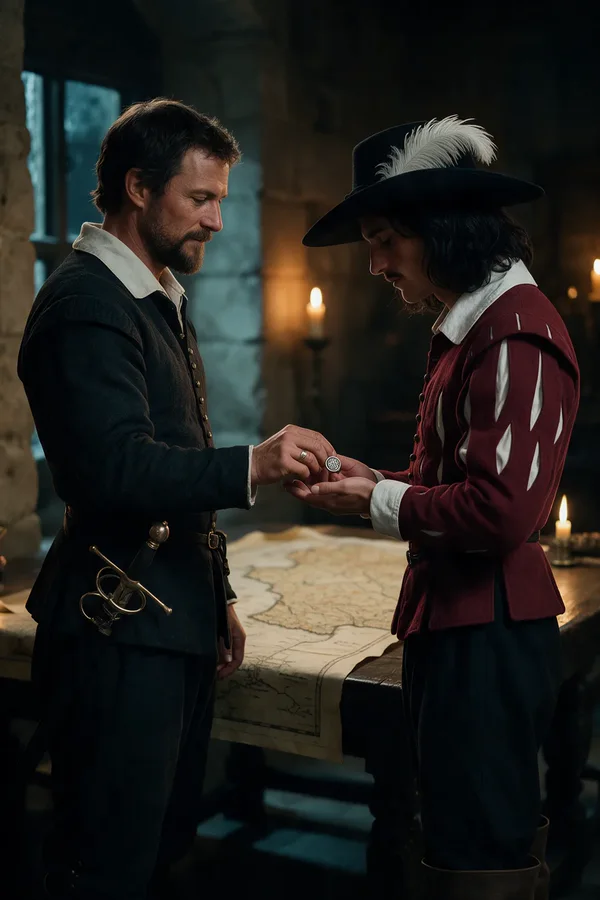
With these words Henry comes closer and places a small silver ring in your hand. To your surprise, you notice his initials not on the outside but on the inside of the ring. Meanwhile the King finishes:
“I understand perfectly how dangerous and unpredictable your road will be, so I shall not take offence if you throw this ring away as soon as you realise it may do more harm than good. But along your route the right people have been warned: the ring is a sign that you have been sent by me. Yes, the most important thing. When you meet the man you are riding to, give him just these words: ‘Dawn is near.’ It is a prearranged signal, meaning… However, it will be better for you not to know anything more than you need. My treasurer has already been ordered to give you 15 écus. Is anything still unclear? No? Then farewell, and may God help you!”
Utterly stunned, you leave the King’s apartments and, having received the money, decide that the wisest thing is to go to bed early. Half an hour before dawn a servant wakes you (with a smile you recall in passing the prearranged phrase the King spoke the evening before) — it is time to set off.
And now, if you are ready for the traps and adventures that await you and are determined to test the long patience of Fate, turn the page, and may luck go with you!
How the book begins
A servant leads Arbalest out of the stables, and you leap lightly into the saddle. Quiet provincial Agen is still asleep; the clatter of hooves echoes over the cobbles. At the gate you have to use the King’s ring for the first time: the sleepy guard, tumbling out of the guardroom, dare not break the Governor’s strict order that no one is to be let out of the town. Henry has taken the necessary precautions: now you can be sure that not even the most cunning spy could have left Agen ahead of you. But now the gate is behind you, and you must decide which road to turn your horse onto: to Villeneuve or to Cahors?