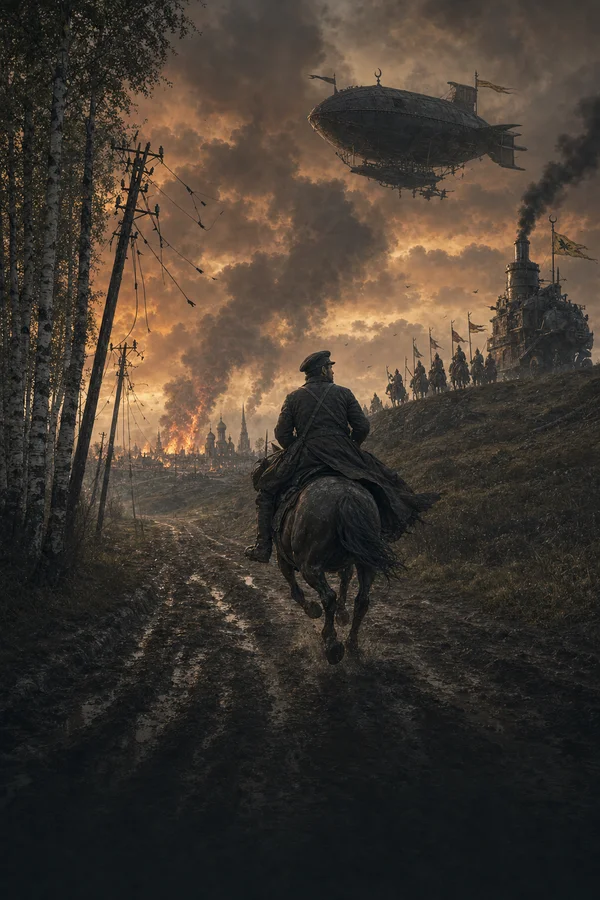
July. Siberia is in revolt and the telegraph wire is cut. Michael Strogoff, courier of the Tsar, must carry a letter under a false name to besieged Irkutsk—and get there before the traitor who is bound for the same city.
Rules
You are Michael Strogoff, courier of His Majesty the Tsar. Everything described below is counted for you by the web version.
AGILITY and STRENGTH are set by a roll of the die against a table. STRENGTH is your life: at zero you die; each meal restores 2 STRENGTH. A clumsy hero is tough as rawhide: with AGILITY 7–10, from 1 to 10 is added to STRENGTH.
COVER (5 at the start) is your story as the merchant Nicholas Korpanoff. A brawl in public, a podorojna shown in an occupied town, a careless word—each of these costs you COVER; a story well told wins it back. At zero you are unmasked, and the journey is over.
DAYS. Headquarters reckons that Irkutsk can hold out for fifty days. Arrive later, and there is no point in carrying the letter at all. You must eat on every day of the journey: a day without a meal costs you STRENGTH. You may also eat from your provisions at any moment—there is a button for it on the Sheet.
Skill: one of five. Wherever it helps, a button marked with a star ✦ appears among the choices. Every obstacle can also be overcome without it.
Fighting. ATTACK STRENGTH is die × 2 + AGILITY; whoever scores higher wounds the other. Before a fight you may fire your revolver once—a sure shot (−4 STRENGTH to the enemy) or a chance shot (bring him down or miss). You have six cartridges.
Luck is a roll of the die: an even number means you are lucky.
Thresholds. When a choice label ends with, say, “[STRENGTH 12+]”, the outcome depends on that characteristic: high enough, and you get through; too low, and you do not. Choose with your eyes open.
The bag holds five things. The knife, revolver, cartridges, provisions, papers and transport are carried outside it.
How the book begins
“The wire is cut beyond Tomsk. The last dispatch came through an hour ago.”
It is said under the breath, in passing, behind the half-open door of the guardroom—but a courier’s ear is tuned to words like these. General Kissoff is all but running down the corridor of the New Palace, a crumpled strip of telegraph tape in his fist. Beyond the wall, in St George’s Hall, a mazurka thunders, spurs ring, silks rustle: the Kremlin is dancing and knows nothing.
You are thirty years old. You were born in Omsk, the son of a Siberian hunter, and you have spent half your life in the saddle, carrying across the empire papers that cannot be trusted to the wire. Tonight there is no wire.
The door flies open. The aide-de-camp is pale; he is pulling his glove onto the wrong hand.
“Courier Strogoff? To the General. At once.”
You straighten your tunic. The aide is already moving—down the corridor, then along the edge of the ballroom, past the columns and the whirling couples. By one of the columns two men in evening dress are not dancing: they are watching the spot where the General has just passed.